SPERM FACTS

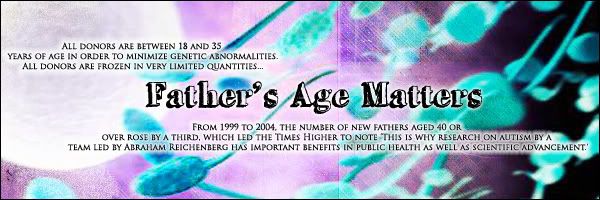
^^ Click to view at full size

Male Health: The Long Shot
From puberty on, reproductive health and the viability of sperm continue to evolve.
By: Mark Teich Psychology Today
Teens
Until age 13 or 14, sperm is not fully formed, increasing the risk of infertility or birth defects. Sperm may be extremely healthy in older teens, who are famous for their potency. But risky teen behavior may put sperm at risk.
20s
These are prime years for male reproduction. Men have the maximum amount of mature sperm cells and the least DNA damage. The risk of producing birth defects or causing other problems in offspring is as low as it ever will be.
30s
Testosterone levels start to decline at age 30, bringing a decrease in potency. By 32-34, fertility begins to fall. Men who are 35 or older are twice as likely to be infertile as men under age 25. The mid-thirties also bring a significant increase in sperm DNA damage and thus an increased risk of producing birth defects. One in 99 fathers ages 30-35 sire children with schizophrenia versus one in 141 for fathers under age 25.
40s
Type 2 diabetes and metabolic syndrome, involving pre-diabetes symptoms and cardiovascular risk factors, start to occur more often in men. Both disorders are strongly associated with below-normal levels of testosterone, lowering potency. Erectile dysfunction (ED) starts to be a problem in a number of men. The risk of schizophrenia doubles in children of fathers in their late forties compared with children of fathers under age 25. Men 40 and older are nearly six times more likely to have offspring with autism than men younger than 30.
50s
Erectile dysfunction increases for many men. By age 50, the DNA cells that create sperm have gone through more than 800 rounds of division and replication, vastly decreasing the quality of sperm and increasing the chances of mutation and birth defects. The risk of schizophrenia almost triples for children of fathers 50 and older; one in 47 fathers sires a child with the condition.
60s
At the age of 60, 85 percent of sperm is clinically abnormal, something researchers attribute to normal aging.
From puberty on, reproductive health and the viability of sperm continue to evolve.
By: Mark Teich Psychology Today
Teens
Until age 13 or 14, sperm is not fully formed, increasing the risk of infertility or birth defects. Sperm may be extremely healthy in older teens, who are famous for their potency. But risky teen behavior may put sperm at risk.
20s
These are prime years for male reproduction. Men have the maximum amount of mature sperm cells and the least DNA damage. The risk of producing birth defects or causing other problems in offspring is as low as it ever will be.
30s
Testosterone levels start to decline at age 30, bringing a decrease in potency. By 32-34, fertility begins to fall. Men who are 35 or older are twice as likely to be infertile as men under age 25. The mid-thirties also bring a significant increase in sperm DNA damage and thus an increased risk of producing birth defects. One in 99 fathers ages 30-35 sire children with schizophrenia versus one in 141 for fathers under age 25.
40s
Type 2 diabetes and metabolic syndrome, involving pre-diabetes symptoms and cardiovascular risk factors, start to occur more often in men. Both disorders are strongly associated with below-normal levels of testosterone, lowering potency. Erectile dysfunction (ED) starts to be a problem in a number of men. The risk of schizophrenia doubles in children of fathers in their late forties compared with children of fathers under age 25. Men 40 and older are nearly six times more likely to have offspring with autism than men younger than 30.
50s
Erectile dysfunction increases for many men. By age 50, the DNA cells that create sperm have gone through more than 800 rounds of division and replication, vastly decreasing the quality of sperm and increasing the chances of mutation and birth defects. The risk of schizophrenia almost triples for children of fathers 50 and older; one in 47 fathers sires a child with the condition.
60s
At the age of 60, 85 percent of sperm is clinically abnormal, something researchers attribute to normal aging.
Labels: 85% of sperm found to be abnormal by 60, Male Biological Clock and genetic disease
posted by concerned heart @ 6:29 PM
0 comments


 Stumble It!
http://www.stumbleupon.com/submit?url=http://www.yoursite.com/article.php&title=The+Article+Title
Stumble It!
http://www.stumbleupon.com/submit?url=http://www.yoursite.com/article.php&title=The+Article+Title


